Sports in Kota
Hockey rules for beginners: how field hockey is played and scored
Written by Kota Sports Editorial Team · Updated
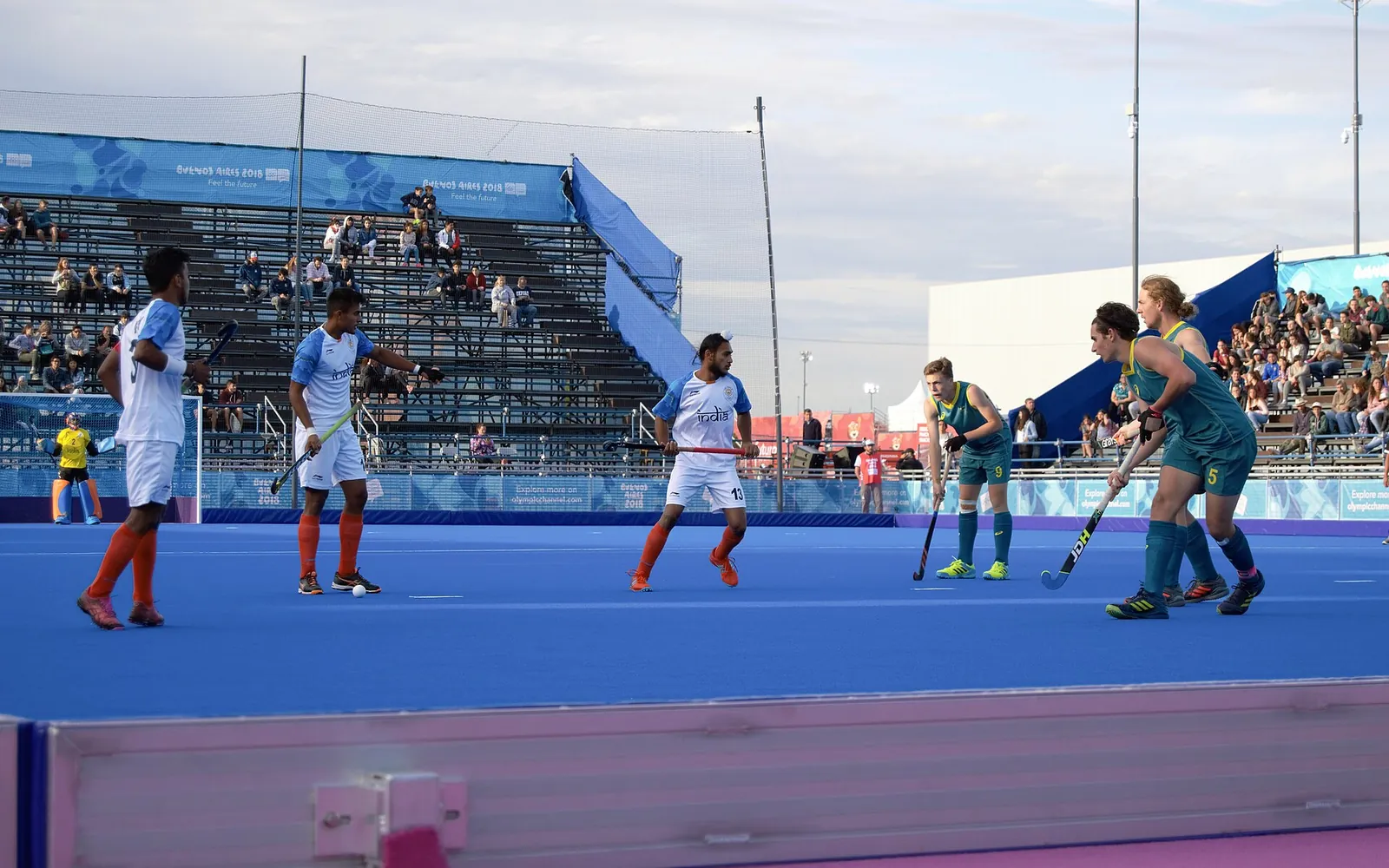
Hockey has a proud history in India, and many Kota schools still put out hockey teams for inter-school and district events. Yet most beginners pick up the game by watching and copying, and only learn the rules when the umpire’s whistle goes against them. This guide explains the hockey rules for beginners in plain language: team size and match length, how goals are scored, what you can and cannot do with the stick, and how free hits, penalty corners, penalty strokes and cards work. It covers outdoor field hockey as played under the rules of the International Hockey Federation (FIH). Local, school and age-group events sometimes adapt them, so always read the event rules too.
To find grounds, coaching and the competition path in the city, see our guide to hockey in Kota.
Teams, pitch and match length
- Each team has eleven players on the field: ten field players and one goalkeeper. Teams may use substitutes, and in most competitions substitutions are rolling, so players can come off and go back on.
- A full-size pitch is about 91.4 metres long and 55 metres wide. Lines cross the pitch at the halfway point and 23 metres from each back line.
- At each end is a goal 3.66 metres wide and 2.14 metres high, and in front of it the shooting circle (often called “the D”), which extends about 14.6 metres (16 yards) from the goal.
- A match is four quarters of 15 minutes under current FIH rules, with breaks between quarters and a longer interval at half-time. Junior and school events often use shorter quarters or halves.
- Matches are controlled by two umpires, each covering roughly one half of the pitch.
Modern hockey at good level is played on artificial turf. Many school and local games in Kota are still played on grass or earth grounds, where the ball bounces unpredictably and play is slower.
How goals are scored
A goal is scored when the whole ball crosses the goal line between the posts and under the crossbar, after being played by an attacker inside the shooting circle. This is the single most important rule for new players:
- A shot from outside the circle that goes straight in does not count.
- A shot from outside that is deflected in by an attacker inside the circle does count.
- If the ball goes outside the circle after the last attacking touch and then goes in, it does not count.
This is why hockey teams work so hard to get the ball into the circle, and why defenders work just as hard to keep it out.
Stick and ball rules
- Field players may play the ball only with the flat face of the stick (including the edges). Playing it with the rounded back is a foul.
- Field players must not stop, kick or carry the ball with their feet, legs or body. A hand holding the stick counts as part of the stick.
- Players must not hit, hook, hold or strike an opponent’s stick or body.
- A player must not raise their stick in a way that is dangerous, for example a wild backswing near other players.
- The ball must not be raised dangerously, especially towards players within about 5 metres.
- Obstruction is a foul: you cannot use your body or stick to block an opponent from playing the ball, for example by turning your back to shield the ball.
- The goalkeeper, inside their own circle and wearing full protective kit, may use any part of the body to stop or deflect the ball. Outside the circle, goalkeepers follow the same rules as field players.
There is no offside rule in modern field hockey.
Free hits and restarts
When a foul is committed, the other team receives a free hit, usually where the foul took place.
- Opponents must be at least 5 metres from the ball.
- The ball must be stationary, and it can be pushed or hit. Under current rules the taker may also start by dribbling it themselves, often called a self-pass.
- For a free hit to the attack inside the 23-metre area, all players must be at least 5 metres away and the ball must travel at least 5 metres, or be touched by another player, before it enters the circle.
- When the ball goes over the sideline, the other team restarts with a free hit from where it went out.
- When the ball goes over the back line off an attacker, the defenders restart with a free hit from up to 15 metres in front of the back line, in line with where it went out.
- When the ball goes over the back line off a defender unintentionally, play restarts with a free hit to the attack on the 23-metre line, in line with where it went out.
Penalty corners
The penalty corner is the most famous set piece in hockey. It is awarded mainly for a defensive foul inside the circle that did not prevent a probable goal, for a deliberate foul by a defender inside their own 23-metre area, or when a defender deliberately plays the ball over their own back line.
How it works:
- An attacker places the ball on the back line inside the circle, at least 10 metres from the goal post, and pushes or hits it out to teammates waiting outside the circle.
- Up to five defenders, including the goalkeeper, start behind the back line. The rest of the defending team must be beyond the halfway line until the ball is played.
- The ball must travel outside the circle before a shot can be taken. It is then stopped at the top of the circle and played back in.
- If the first shot is a hit, it must cross the goal line no higher than the backboard (460 mm) for the goal to count. Flicks and drag-flicks may rise higher as long as they are not dangerous.
Penalty strokes
A penalty stroke is awarded when a defender commits a foul in the circle that prevents a probable goal, or commits a deliberate foul in the circle. One attacker takes it from the penalty spot, 6.4 metres in front of goal, against the goalkeeper alone. The ball may be pushed, flicked or scooped, but not hit, and the taker may play it only once.
Cards
Hockey umpires use three cards:
- Green card: a warning plus a short temporary suspension. At international level it is two minutes off the field; national rules can vary.
- Yellow card: a longer temporary suspension, with the length set by the umpire, often for repeated or more serious fouls.
- Red card: permanent suspension from the match.
A suspended player cannot be replaced, so the team plays short until they return.
Safety rules beginners must follow
- Shin guards and a mouthguard are strongly recommended, and many competitions require them. Goalkeepers must wear full protective equipment, including a helmet.
- Keep your stick below shoulder height near other players unless you are safely playing a ball in the air.
- Never swing at a ball that is among other players’ feet.
- On hard, dry Kota grounds in summer, drink often and train in the cooler hours; see our guide to playing sports in Kota heat.
Rules beginners often get wrong
- “Any shot into the goal counts.” Only shots touched by an attacker inside the circle count.
- “You can stop the ball with your foot if it is an accident.” An accidental touch that gives no advantage may not be penalised, but deliberate use of the feet is always a foul.
- “There is offside in hockey.” Not in the modern game.
- “The goalkeeper can kick anywhere.” Only inside their own circle.
Learning the rules in practice
Ask your coach to run small-sided games with the circle rule enforced, and to explain each whistle. Build the running fitness hockey demands with our guide on how to improve stamina for sports, and always do a proper warm-up before sports to protect hamstrings and ankles. For finding school, district and open events, see sports tournaments in Kota. Hockey India publishes national competitions and news, and the FIH publishes the official rules of hockey on its website.
For guides to every other sport in the city, browse our Kota sports guides.
Frequently asked questions
How long is a field hockey match?
Under current FIH rules a match is four quarters of 15 minutes, with a short break after the first and third quarters and a longer half-time interval. School and local events often shorten the periods, so check the event rules.
Can you score from outside the circle in hockey?
No. A goal only counts if the ball is played by an attacker inside the shooting circle and does not go outside the circle before crossing the goal line. A long shot from outside the circle that goes straight in is not a goal.
What is a penalty corner in hockey?
A set piece awarded mainly for defensive fouls inside the circle, or deliberate fouls by defenders inside their own 23-metre area. An attacker pushes the ball from the back line, at least 10 metres from the goal post, and up to five defenders including the goalkeeper start behind the back line.
Can you use the round side of the stick in hockey?
No. Field players may only play the ball with the flat face of the stick, including its edges. Playing it with the rounded back is a foul.
What does a green card mean in hockey?
A green card is a warning combined with a short temporary suspension. In international matches the player leaves the field for two minutes; national and local rules may differ. A yellow card is a longer suspension and a red card means the player is sent off for the rest of the match.
Sources
Editorial team
The Kota Sports team writes and updates these guides to sport in Kota, Rajasthan, checking facts against official sources and saying clearly where readers need to confirm details with a venue or organiser.